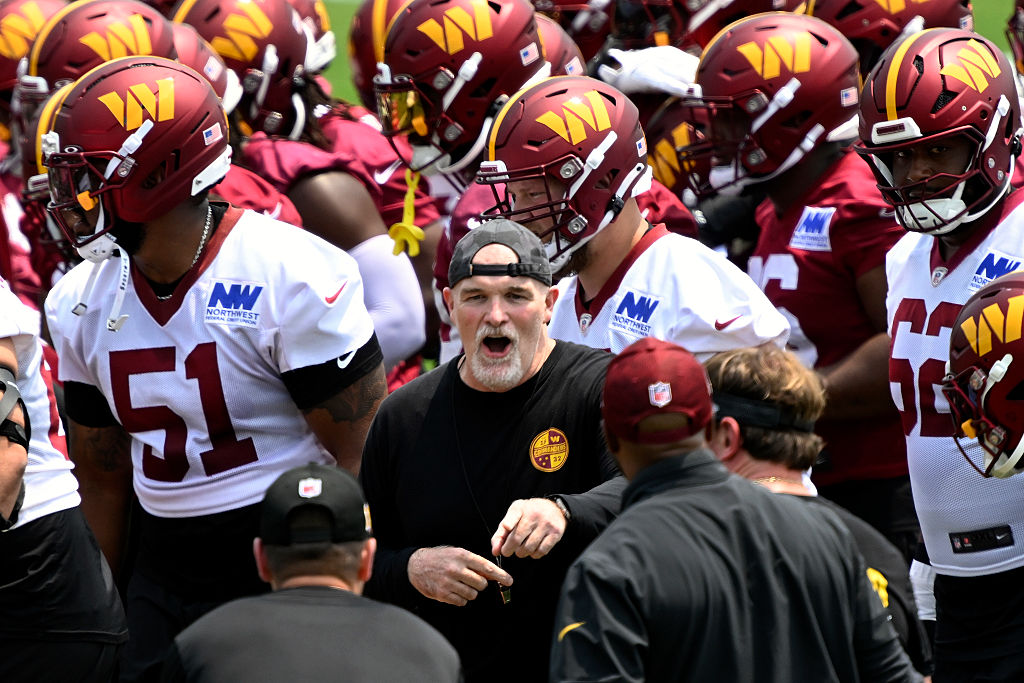
When the Washington Commanders took the field for the first day of mandatory minicamp, the most interesting part of the day had nothing to do with a highlight catch or a big throw from Jayden Daniels.
It was the message behind the practice.
Reporting from Ashburn, ESPN Radio’s Lake Lewis Jr. highlighted the energy on the field and Dan Quinn’s emphasis on competition throughout the roster. That focus says a lot about where the Commanders are as an organization and where they believe they need to go next.
The first phase of Adam Peters’ rebuild was about credibility. Washington had to become a place where good football players wanted to play. The roster needed veterans. The locker room needed leadership. The organization needed stability.
That work is largely done.
The challenge now is different.
The Commanders are no longer trying to prove they belong in the conversation. They are trying to prove they can stay there.
That’s why this offseason looked different from the previous two. Peters moved away from relying on short-term veteran fixes and instead invested heavily in younger players entering the prime years of their careers. The goal was not simply to improve the starting lineup. It was to create competition throughout the roster.
Quinn’s comments before practice reflected that reality.
Every NFL team talks about depth. Every NFL team says the bottom half of the roster matters. The difference is that Washington now has legitimate competition for jobs across multiple position groups. Coaches are not simply evaluating players anymore. They are comparing players. They are looking for contributors, rotational pieces and future starters.
That process begins during weeks like this.
Mandatory minicamp is one of the few opportunities before training camp where coaches can get an extended look at the entire roster on the field together. Decisions are not made in June, but impressions are. Players earn trust. Coaches identify strengths. Depth charts begin taking shape.
For Washington, that matters as much as anything happening with the starters.
The Commanders spent the offseason getting younger and faster. They added players they believe can help them compete now, but they also added players who should still be part of the foundation several years from now. That’s a very different approach than the one that carried the roster through the early stages of the rebuild.
Whether it works will not be determined this week or even this summer.
But the first day of minicamp offered a reminder of what this offseason has really been about. Washington is no longer building a roster capable of surprising people. It is trying to build one capable of sustaining success.
That is a much harder challenge.
It’s also the challenge that will define the next chapter of the Peters-Quinn era.
Conor Forrest is the Editor-in-Chief and Senior NFL Insider at SportsJourney.com, where he covers the Washington Commanders and the league at large. A Northern Virginia native and George Mason University graduate, his work has appeared in FanSided, NBC Sports Washington, Heavy.com, and The Fourth Estate. He is also the host of the “After Further Review” podcast, reaching a global audience with his analysis and storytelling.












Leave a Reply