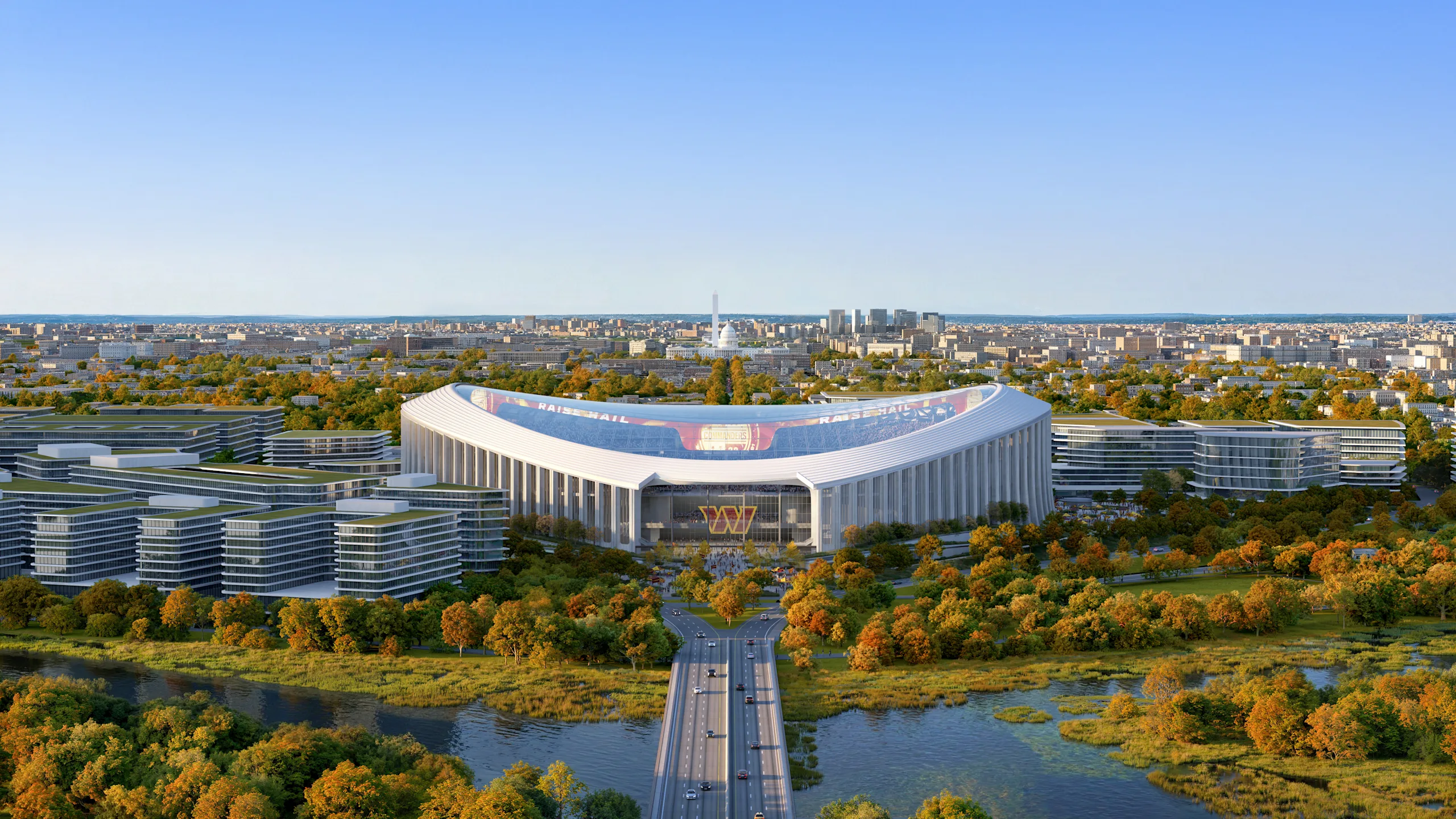
The Washington Commanders took their first visible step toward a return to the District on Thursday, unveiling incredible conceptual designs for a new enclosed stadium that would anchor a broader redevelopment of the historic RFK Stadium site and reshape the city’s eastern waterfront.
The early renderings, developed with global architecture firm HKS, outline a roofed venue capable of hosting more than 70,000 fans while operating as a year-round destination for concerts, civic events, and community gatherings. Team officials framed the stadium not as a standalone football facility, but as a long-term civic investment designed to reconnect neighborhoods, parks, and the Anacostia River.
Unlike traditional stadium projects that prioritize scale above all else, the Commanders’ proposal emphasizes integration with Washington’s historic urban plan. The building is oriented along the L’Enfant Plan and intentionally shaped to preserve sightlines toward the U.S. Capitol and surrounding monuments. A transparent domed roof would rise gradually from east to west, balancing a modern profile with the city’s famously protected skyline.
Commanders president Mark Clouse said the concept reflects a deliberate attempt to blend innovation with legacy.
“This is about creating something that feels unmistakably Washington,” Clouse said. “We’re honoring what RFK Stadium represented for generations of fans while designing a place that works for the city every day of the year, not just on Sundays.”
The stadium would sit within a mixed-use campus that expands public access to green space and the waterfront. Project leaders said at least 30% of the site would be dedicated to active and passive recreation, including plazas, walking paths, and open areas intended to remain accessible even when the stadium is not hosting events.
HKS Global Venues Director Mark A. Williams described the project as one of the firm’s most historically sensitive undertakings, drawing inspiration from RFK Stadium’s openness and civic presence while reinterpreting it for a modern era of sports and entertainment.
District officials echoed that vision. Mayor Muriel Bowser called the project a potential economic engine for Ward 7 and the surrounding area, citing job creation, small business opportunities, and increased year-round activity tied to the redevelopment of the RFK campus.
Community engagement has already played a role in shaping the design, according to the team, with additional public meetings planned through January as details continue to evolve.
While the renderings remain conceptual, the Commanders estimate construction could be completed by 2030, marking a symbolic homecoming to the site that once defined football in the District. For a franchise seeking stability and a deeper connection to its city, Thursday’s unveiling represented less a finished product and more a statement of intent that Washington’s next stadium aims to belong to the city as much as the team that plays inside it.










Leave a Reply